Controlled Release · Doctrine Aperture
A program held quiet since 2009. The reason it stayed quiet — and the reason we are speaking now.
After months of deliberation with the team, security, and OYC about allowing non-government officials to look at our canine program — a program that has been kept very close and confidential since 2009 — a compromise was made.
We agreed to share the general Terminal Learning Skillsets for the canines without rolling out the individual segments within each skillset.
We believe it is fair to share the global template of what our canines go through — and why this is such a comprehensive, complex program with years of development behind it.
You might ask why it has been so confidential. The answer is very simple.
Every program has its own foundations and its own specific purpose.
- The military doesn't go to the police to learn how to run special operations in the fields of Iraq or the jungles of Colombia searching for narco-cartel members.
- The police don't take their dogs to the military to learn how to teach their dogs to kill people — that application has no need on the street.
- TSA detection dogs don't go to a police school to learn apprehension bites and techniques — their sole job is detection of narcotics or explosives.
- Cadaver dogs don't go to special operations schools to learn to rappel out of helicopters or fast-rope — their job is to look for human remains.
Every discipline has its own purpose. Every program is built for the environment it serves.
The one area that was left out — and not considered — was corrections.
Primarily because in law enforcement, corrections is not looked upon as a desired field to go into.
Who would want to go into a field where you are surrounded constantly by violent, manipulative, psychotic inmates of all different variances and backgrounds?
And when you think about it — the corrections officers serve about just as much time in prison as the inmates they guard. When you tally up how many hours a day they work, how many days a week, and count it all up by the time they retire — they've done more time inside than your average prisoner.
In the military, in the police, and in every other public safety and working-line industry, handlers have a place they can go during their shift to relax, unwind, and let the dogs cool down.
It is constant chaos from the time you walk in to the time you leave. That is unimaginable stress — on a canine, let alone on the human beings walking beside them.
- They are walking constantly on concrete.
- They move from concrete room to concrete room, through steel doors that bang and thud as the locks throw.
- The chaos on the inside — the manipulation, the odor, the smell — they cannot leave it.
- Once they start their shift, they smell it from the time they go in until the time they walk out.
Every sense on the human body — and on a canine — is engaged the entire shift. Smell. Sight. Audio. Feel. All of it. All at once. All day.
It was for this reason — after looking at the limitations of a traditional police canine program and the limited applications of a military K9 program inside the prison — that this program was built from a blank page.
- We don't apprehend in prison. We have introduction engagements. The reason we don't apprehend is because the inmates are already arrested. Where are we going to take them — to prison? They're already there.
- Police have apprehension because they are trying to stop an individual and take him to jail.
- The military has neutralization — the program used when the engagement gets to that point with a hostile force.
Every public safety realm has specific needs and specific uses for their canines.
In corrections, ours was primarily developed for kinetic face-to-face operations. In the majority of how law enforcement working dogs are used, the engagement happens at a distance — inside the line of safety. Here in corrections, it is in your face. Our programs had to deal with the kinetic one-to-one, five-to-one, ten-to-one reality.
So what you are looking at is a unit — one of the most recognized Corrections Special Operations units in the world.
- We utilize the latest in technology, weaponry, and tactics.
- Our operator program alone is nearly a year long.
- We carry one of the highest washout rates for special operations — an over 85% washout rate of all candidates who apply for the program.
We decided to release the global template in general as an outreach to the canine working community.
We have been a community that has been very silent, very quiet. We thought this was the time to do a reach-out.
This program has been utilized in nearly 1,000 jails since 2009. The combined introduction engagements for canines are well over 1,200.
That is a quiet track record for us. Yes — we are in a target-rich environment. Yes — we are deployed normally to deal with high-intensity inmate conflict. And yes — we have learned a great deal of lessons.
On an as-needed basis, we will allow other Special Operations Unit breeds to come in and learn certain skillsets from us.
That has been the only exception.
The Bite Doctrine That Corrections Forced Into Existence
Why the police foundation failed. Why the military foundation failed. Why we had to build a new one.
The canine foundation is a hybrid of military and police foundations — modified specifically for the corrections environment.
The bite doctrine was developed as a result of the limited application use on individuals who are incarcerated. It was designed to meet the threats posed by these individuals — who come from gang affiliations, narco-cartel affiliations, and global organized violent crime organizations — and the way they deal with canines.
That forced us to come up with a different doctrine — one written for the environment that broke every other foundation before it.
K9 CenterThe Doctrine · The Science · The Pack
You are looking through Class-IV ballistic glass into the operational core of the US-CSOG K9 program — a science-first, doctrine-first, high-threat corrections special operations K9 capability with lineage traced to the first CSO K9 fielded in the United States, 2009. You may observe. You may not enter. Interior detail, phase doctrine, video rooms, and specialist team rosters require verified CSO handler credentials.
KILO-1 · The Working Rig
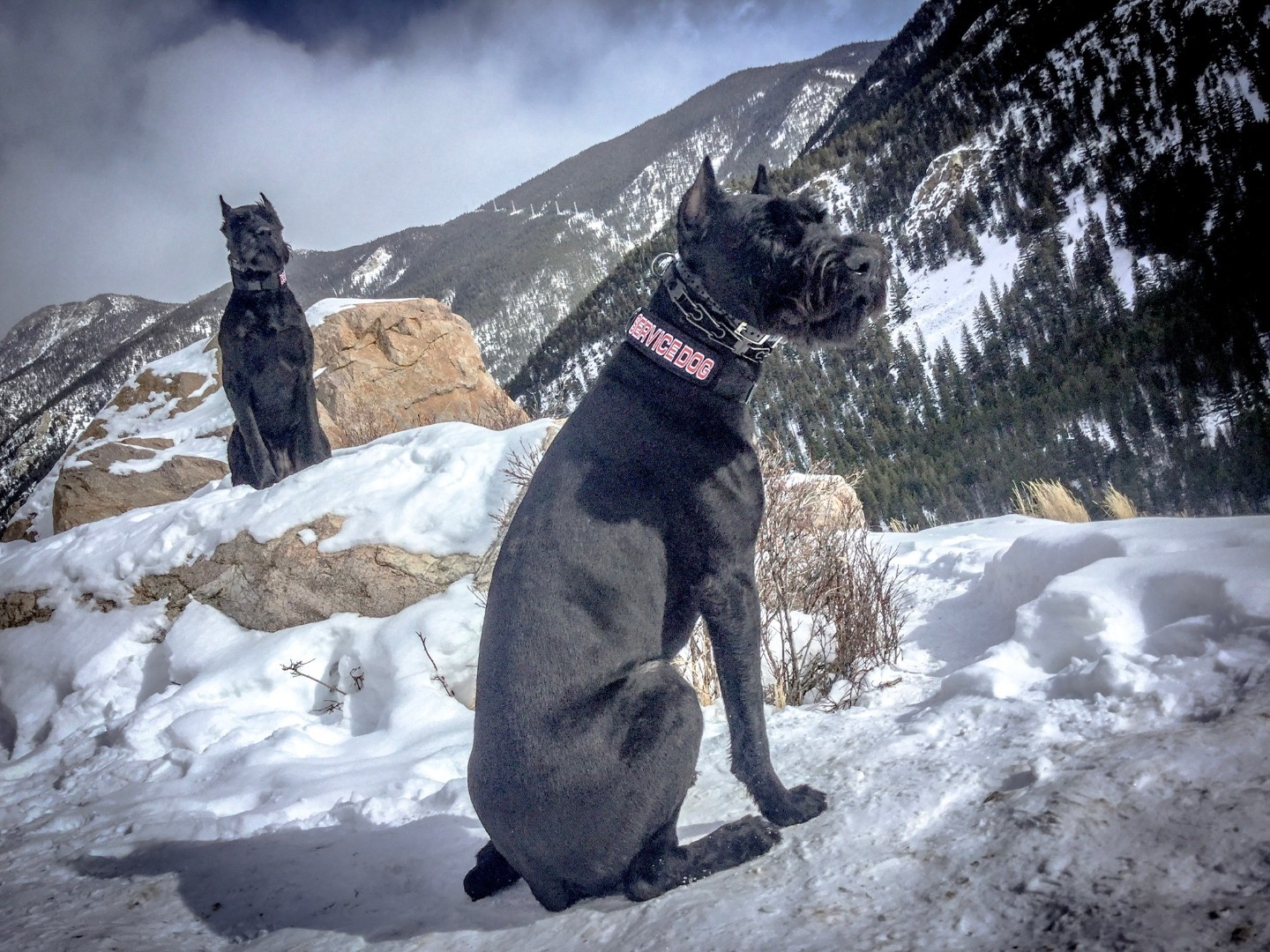
Every US-CSOG K9 wears a working rig cut for real deployment — not for a photo. Callsign patch, US flag, red working collar, load-bearing chest plate rated for high-angle, vehicle, and rotor-wash operations. When you see KILO-1 on the harness, you are looking at the doctrine's callsign of record, the identity dog of the CSO K9 program.
- ◆ Callsign of record · KILO-1
- ◆ Rig standard · US-CSOG issue · Every operational K9
- ◆ Working line · Giant Schnauzer · High-drive
- ◆ Deployment classification · Handler-Only
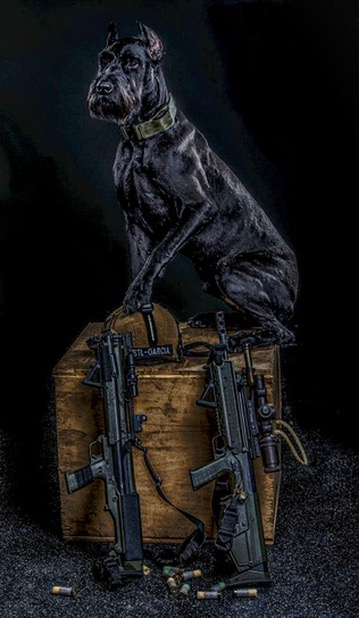
Leader of the Pack
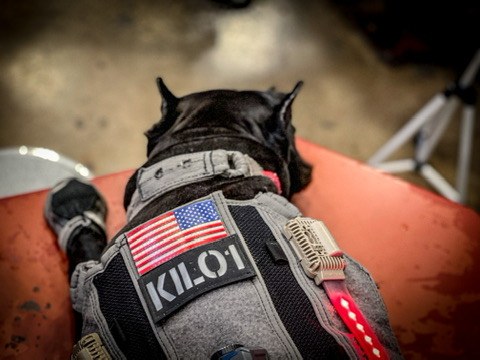
His name was CSO K9 MAX. He was the first — the dog who walked point when the doctrine was still a blank page. Over 280 documented interdiction engagements with inmates, inside cell blocks that had no map for a working K9, he wrote the rules the rest of the pack still follows. Every phase, every tile, every team on this wall traces back to the ground his paws first covered.
- First Giant Schnauzer in United States history to be certified as a Corrections Special Operations K9.
- First US law enforcement K9 guided by the SE532 green laser and light system for orientation, detection, and interdiction focus — during a major facility riot, directed to a violent ring-leader posted on the second tier and taken down clean.
- First K9 to transition into the K1K9 Combat Transition — the model every high-performance CSO K9 is now built against.
- First K9 to operate 100% off-lead inside over 300 correctional facilities across the country.
- Set the CSO K9 standard the entire current program is built on — every SOP, every phase progression, every deployment protocol carries his fingerprints.
His name will forever be over the halls of the K9 program. We do not walk past it. We salute it, and we go to work.
42 Phases · 4 Packages · One Pack
What These K9s Actually Go Through
01The Two Pipelines · 34 TLS · 22 TLS · 0430 Every Day+
K9 Terminal Learning Skillsets (TLS) — every skill set the canine must terminally master before advancing. Not phases. Not blocks. Skillsets.
- All training begins at 0430 for all canines in all groups. Every day. No exceptions.
- Weekly breakdown and weekly FTX are classified — reserved for Special Ops K9 units. Registration and clearance required for interior access.
- TLS blocks can overlay other blocks depending on the program and speed of the group. No K9 ever skips a TLS or a skill set.
02The Mentor-Puppy Group System · 6mo Pairs with 24mo+
All dogs entering the program are placed into mixed-age mentor groups. The pack trains the pack.
- A 6-month-old is paired with a 12-month-old, an 18-month-old, and a 24-month-old — and that group trains together in mentor-puppy development throughout the entire program.
- Maximum of three groups moving through any phase of the program at any given time. No overcrowding. No dilution of instruction.
- PSSD and CSO run Phase 1 together. At the end of Phase 1, the PSSD dogs branch into the PSSD pipeline.
- Joint group exercises and socialization development happen throughout the year — all groups come together for cross-training.
03The Medical Standard · X-Rays Every Phase · 1-Hour Vet Trauma+
The bar for medical clearance at K1K9 is not comparable to conventional K9 programs. It starts before the dog ever enters and continues at every phase boundary.
- Vet-cleared before entry — canines are cleared by a dedicated vet team comprised of general practitioners and specialist veterinarians. No dog enters without full medical vetting.
- Full medical clearance after every TLS — no exceptions. X-rays and blood work are taken at the beginning and end of every TLS to confirm the canine is sound and has sustained no injury.
- Urgent-care canine medical office on standby 24/7 — fully stocked with emergency trauma equipment. Serves all training classes and every exterior activity.
- Certified Vet Tech on-site 0300–2200, 7 days a week, at the K1K9 HP Center.
- Comprehensive canine medical bag travels with every group. No exceptions.
- Contract with a major veterinary medical hospital providing 24/7 emergency trauma service — any K9 to a Vet Trauma Center within 1 hour of any incident.
- PSSD clients receive 24/7 camera access — log in and see where their canine is, or what it is doing, any hour of any day.
04Retest · Recycle · Redirect · The Fair Pipeline+
No canine in the pipeline ever skips a TLS or a skill set. If a dog shows weakness in a general topic, the door is not closed — it is redirected.
- Retest — if a canine fails a test, it has the ability to retest.
- Recycle — depending on scoring, the canine can be recycled through the TLS.
- Redirect to PSSD — dogs removed from the CSO program are placed into the PSSD program at their current training level.
- Adoption ladder — dogs that cannot be placed in the PSSD program are put up for adoption at their current training level. Adopted families can have the dog redirected with specific skill sets at a reduced price. Families are placed on a waiting list and matched.
- No dog is discarded. Every K1K9 canine has a path.
05K9 Gear · The Quartermaster · Built for Our Dogs, Not Off-the-Shelf+
At US-CSOG we operate our own quartermaster. We build all of our prototypes in-house and send them to specific manufacturers for production. This is deliberate.
- Most K9 vests on the market are built for general purpose. Ours are not.
- We build our vests specifically for our dogs — as slick as possible, fully integrated, minimal signature.
- Integrated lights, technology, and leashes — built into the platform, not clipped on.
- Slide-in body armor and technology slots — modular protection scaled to the mission.
- Cooling and safety systems — keep the dog cool and operational in high-heat environments.
- Minimal signature — designed to move silently through cell blocks, temporary facilities, sea platforms, and open terrain.
06Placement & Purchase · No CSO K9 Sold to the Public+
- No Corrections Special Operations K9 will ever be sold to the general public. Placement is restricted to government special operations units, diplomatic details, and cleared security units.
- PSSD sales priority order:
- Current clients
- Referral only
- Open placement by pre-cleared applications — first come, first served
- No puppy sales. No partial-trained PSSD sales. No exceptions.
- Both PSSD and CSO canines run Phase 1 together. At the end of Phase 1 the PSSD dogs enter their dedicated pipeline. All groups come together throughout the year for joint group exercises and socialization development.
07Staff Housing · Fully Provided · No Charge to Staff or Guests+
K1K9 provides fully furnished and stocked housing for all visiting instructors and guests — at no charge to the staff.
- Fully furnished accommodations — turnkey, ready on arrival.
- Meals and nutrition provided.
- Staff cars and ATVs available for use at their discretion.
- All at no charge. Visiting instructors and guests focus on the work — not logistics.
The 2.5–3 Year Development Pipeline
The Pack Trains the Pack
Every developing K9 is paired with a proven senior operator — a mentor K9 already deployed and certified. The younger dog does not learn from humans alone. It learns from the pack.
- Mentor pass-down — muzzle work, environmental composure, silent movement, bite discipline, threat recognition, and stack behavior are absorbed dog-to-dog, not solely handler-to-dog. The senior K9 sets the standard the junior meets.
- Live-fire desensitization by proximity — juniors observe mentors working live fire, breach, and CQC before they ever run those lanes themselves.
- Correctional exposure — juniors accompany mentors through real facility movements, structure clears, and operational rehearsals from an early age. They learn the environment before they engage in it.
- Team-cohesion imprinting — juniors learn to read handler intent, operator rhythm, and multi-dog spacing from the mentors already doing it.
- Release protocol — a K9 is only released to solo operational status after mentor and handler certify readiness. The mentor is the final gate.
Four States. No Downtime.
We do not house our K9s in kennels. This is a deliberate operational choice, not a matter of comfort. A working K9 at US-CSOG is always in one of four states:
- Watching training — absorbing the pack's rhythm from the sideline.
- Participating in training — alongside a mentor or as decoy support.
- Being trained — in their own doctrine phase.
- Resting or feeding — in the pack environment, never isolated.
There is no downtime, no isolation, no separation from the pack or the mission environment. This eliminates the mental spikes and valleys that kennel-housed dogs cycle through. Every K9 in this program lives in a constant operational rhythm — which is exactly the rhythm they will operate in downrange.
Every Structure. Every Platform.
Hardened Structures
Traditional purpose-built correctional facilities. Reinforced concrete, sally ports, cell block interdiction, tier movement, and control-center integration. Our primary operational environment.
Temporary Facilities
Field-deployed detention and expeditionary containment. Tent structures, portable modular facilities, and rapid-standup operational sites. Our K9s train inside this environment — not just adjacent to it.
Floating Control Facilities
Prison ships, barge-based holding platforms, and vessel-mounted detention operations. Deck movement, confined-space interdiction, and rotor/marine integration under continuous motion.
Sea Platforms
This is why we train in Zodiac deployment operations with our K9s. Sea-platform interdiction requires a K9 that stages, inserts, and operates from small-boat platforms with no hesitation, no compromise.
The Operator Behind the K9
A K9 is only as sharp as the handler on the other end of the leash. US-CSOG handlers are recruited from a broad operational background — not from generic dog-training pipelines. We select operators who already understand pressure, structure, and mission execution, then teach them the K9.
Our handler pipeline is 12 weeks — focused, compressed, and built for candidates who arrive with the mindset already installed. This is not entry-level training. It is the K9 layer on top of an already-proven operator.
◈ Recruitment Sources
-
01Military SOFSpecial Operations Forces — CONUS and OCONUS. Operators with combat deployment history and doctrine-level tactical foundation.
-
02Police SWATDomestic tactical operators. Warrant service, HRT, hostage rescue, and high-risk interdiction backgrounds.
-
03International LE / MILForeign law-enforcement tactical units and allied military K9/SOF programs. Vetted through bilateral working-dog and interoperability channels.
-
04Corrections Special OpsSTL/SERT/CERT operators with cell-block, tier, and correctional-environment experience. The environment we deploy into most.
K9 Specialist Teams
The Vault Door Is Locked
You have observed the K9 Center from the deck. Interior detail — phase progression standards, video rooms, specialist team rosters, breeder kennel names, decoy contracts, and operational SOPs — is held behind verified CSO handler credentials. If you are a credentialed K9 handler, corrections tactical commander, or federal agency partner: request access.